
There is a peculiar feature of the permitting process that architects eventually learn to fear.
It is not a code section.
It is a new person sitting in the same chair.
Our project at Cresthaven Drive in Pasadena began as an SB 9 lot split. We started working on it in 2021 and spent the following years moving through Pasadena's plan-check process.
The site had an unusual condition: an existing roadway ran through the property and provided access toward Cresthaven Drive. It wasn't something we designed to make the project work. The road had been there for decades.
After approximately six rounds of plan check, we had worked through comments from Zoning, Public Works, Building, Transportation, Water—and Fire.
Fire approved the project.
Then approved it again.
And again.
The City's own plan-check history shows Fire approvals on July 21, 2025, October 21, 2025, and February 5, 2026.
By that point, we were finally near the finish line. The remaining Building corrections were minor: a permit number was missing from a form and the soils engineer's stamp needed to be added to the civil cover sheet.
Add the number. Add the stamp. Resubmit.
Except Pasadena sends a resubmittal back through the departments so they can confirm that nothing affecting their previous approval has changed.
That is where the trouble started.
Same Project. New Reviewer.
The Fire Department reviewer changed.
Nicole, who had previously approved the project, was replaced by Alejandro.
When the project circulated through Fire again, the approval disappeared.
The existing roadway was suddenly not acceptable as Fire Department access. We were told we had to demonstrate legal access, width, all-weather surface, load capacity, grade, vertical clearance, turning movements and other fire-apparatus requirements—or provide compliant access from Cresthaven Drive.
Those are reasonable things for a Fire Department to care about.
But there was an obvious problem:
Fire had already approved the project three times.
Nothing material about the roadway had changed.
The reviewer had.
We met with Alejandro and his manager. We explained that this was an SB 9 project and argued that new off-site improvements should not suddenly be imposed after years of review and multiple approvals.
We revised the drawings anyway. We documented the width, surface, load capacity, grade, clearance, turning movements and maintenance.
Then came unanswered emails, phone messages and more waiting.
Eventually I escalated the matter to senior City staff. By then I wrote that we had reached a point where we didn't know what else to do and might have to take the matter to the state housing authorities.
Nothing worked.
So we went looking backward.
The Answer Was Seventy Years Old
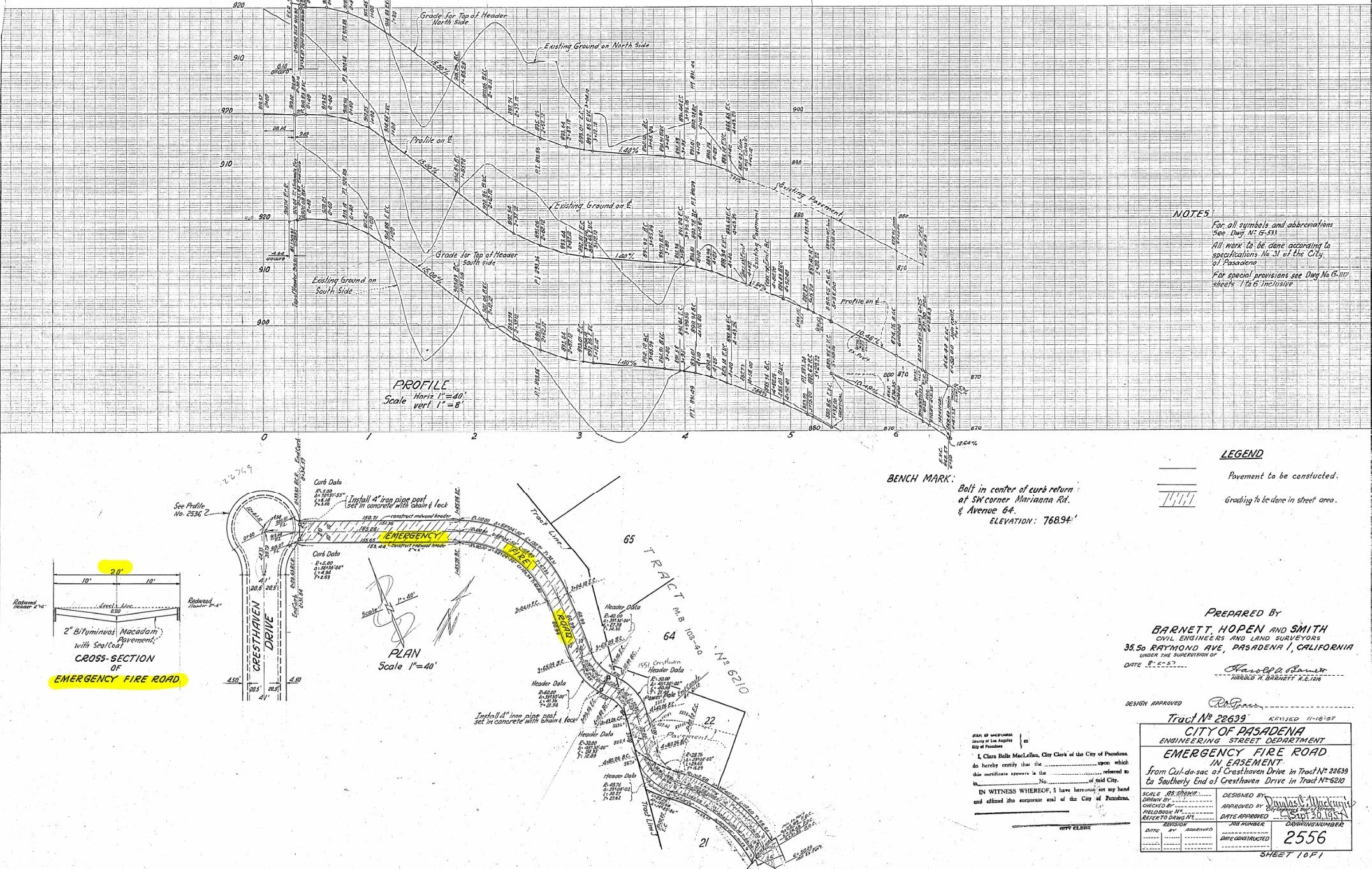
We dug into the historical records and found an old map from the 1950s.
And there it was.
The roadway running through the property was a fire road.
The irony was hard to miss. Back in 2022, years before this dispute, we had already asked Pasadena Public Works for historical information about the termination of Cresthaven Drive in this exact area.
Ultimately, a seventy-year-old document established what years of plan checks and three Fire Department approvals apparently could not.
The project moved forward.
What Does an Approval Mean?
Cresthaven exposed a problem larger than one project.
If every resubmittal gives every department an opportunity to reconsider previously approved conditions, an applicant can theoretically remain in plan check forever.
Correct Item A.
Resubmit.
Someone discovers Item B.
Correct Item B.
Resubmit.
A new reviewer arrives.
Item A becomes a problem again.
For an SB 9 project, that is particularly troubling. The entire purpose of ministerial review is that an applicant should be able to comply with objective standards and receive a predictable result.
There is nothing wrong with correcting a genuine safety problem simply because an earlier reviewer missed it.
But there also has to be institutional memory.
Otherwise, you are not really dealing with a City.
You are dealing with whoever happens to be reviewing the drawings that day.
On Cresthaven, the project didn't change.
The road didn't change.
The Fire Code didn't suddenly change.
The reviewer changed.
And after years of plan check, the thing that finally saved the project was a map drawn when Eisenhower was president.
The Lesson:
Keep every approval.
Keep every email.
And apparently, keep every seventy-year-old map you can find.
Because sometimes the most important drawing on a project isn't the one you're preparing.
It's the one somebody prepared generations before you.
